Coloured shade nets do more than cut light — by tuning which wavelengths reach the crop, they influence photosynthesis, plant shape, flowering and heat load. Ciflower Shanghai designs and manufactures photoselective shade netting on our own 45-foot (13.7 m) seamless Raschel looms, so pigment, mesh density and lifespan are controlled at the loom rather than bought in from an outside fabricator.
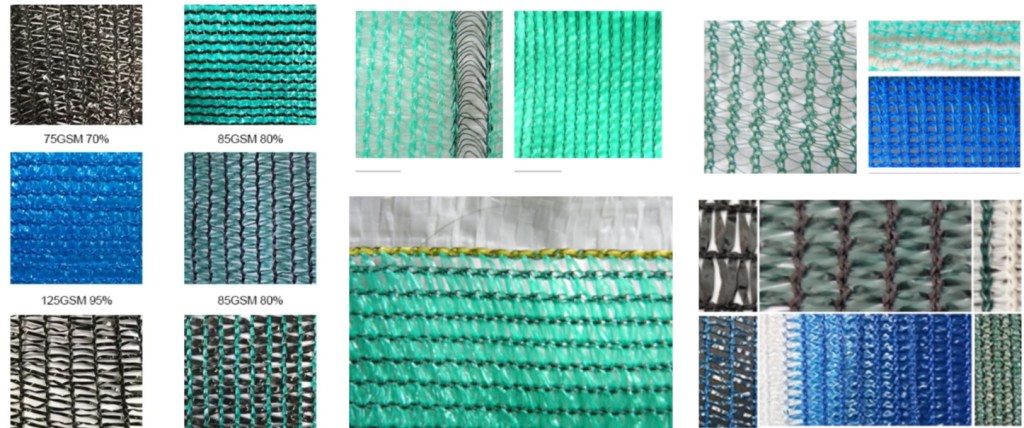
Beyond Black and Green: How Coloured Shade Nets Manipulate Light
For decades, standard black and green shade net has been the workhorse of protected agriculture. It is cheap, durable and does its main job well: lowering light intensity and canopy temperature. But black netting absorbs every wavelength more or less equally, and that bluntness is a limitation once a grower starts optimising for quality rather than just survival.
Photoselective netting takes a different approach. Instead of blocking a flat percentage of the spectrum, it absorbs some bands and transmits others, shifting the red to far-red ratio and the blue share that reach the leaf surface. The result is a measurable change in how the plant grows, not just how much light it receives.
The Science of Photoselective Netting
Traditional black netting absorbs all light uniformly. Photoselective nets modify the light spectrum passing through them, which changes plant behaviour in three main ways:
- Photosynthetic efficiency — delivering the right mix of red and blue light for chlorophyll activity, so the plant converts the light it receives more effectively.
- Morphology — controlling shape and size, for example shorter, sturdier stems and more compact canopy instead of stretched, leggy growth.
- Flowering and fruiting — accelerating or delaying developmental stages so harvest timing can be planned around market windows.
Ciflower’s High-Performance Colour Spectrum
Three specialty colours are engineered for specific outcomes:
Pearl and White Netting — the Cooling Reflector
| Light behaviour | Reflects solar radiation instead of absorbing it |
| Effect on canopy | Lower leaf and air temperature under the net |
| Best for | Germination, propagation, heat-sensitive crops, high-sun regions, retail display |
| Shade rates | 30% to 95% |
Red Netting — the Growth Accelerator
| Light behaviour | Alters the red to far-red ratio reaching the plant |
| Effect on canopy | Influences stem elongation, leaf expansion and flowering timing |
| Best for | Flower and fruit crops where flowering date and quality matter |
| Shade rates | 30% to 95% |
Blue Netting — the Structural Signal
| Light behaviour | Absorbs longer red wavelengths, raises the blue share |
| Effect on canopy | Compact growth, thicker leaves, restrained stem stretch |
| Best for | Leafy vegetables such as spinach, lettuce and cabbage |
| Shade rates | 30% to 95% |
The Ciflower Advantage: Control from the Loom
Suppliers that rely on external fabricators can offer only a limited colour range and basic specifications, because they buy finished roll goods. We build the looms ourselves, which changes what is possible:
- Precise pigment integration — photoselective pigment is dispersed through the yarn rather than applied after knitting, so colour and UV performance stay consistent through the life of the net.
- Density tuning — stitch count and mesh density are set on the machine, so a specified shade rate is repeatable order after order.
- Lifespan control — 100% virgin HDPE with UV stabilizers, knitted on our own machinery, gives 7 to 10 years of functional outdoor life with proper installation and storage.
- Seamless width — up to 45 feet (13.7 m) in one piece, so large structures need fewer panels and fewer seams to fail.
Frequently Asked Questions
Do coloured nets change the shade rate?
No. Shade rate is set by mesh density and yarn construction, so a 70% pearl net and a 70% black net both block 70% of light. Colour changes which wavelengths pass through and how much heat is reflected.
Is photoselective netting worth the extra cost?
It depends on the crop. For high-value flowers, fruit and transplant production, a measurable improvement in quality or harvest timing usually repays the premium within a season. For bulk field shading where light quantity is the only concern, standard black netting remains the economical choice.
Can you produce a custom colour to match our brand?
Yes. Send a Pantone or RAL reference with your shade rate, width and quantity, and we will confirm the minimum order and lead time — usually within one business day.
Request a Photoselective Netting Specification
Tell us the crop, climate and target outcome, and our engineering team will propose a colour and shade rate combination with price and delivery time. Email sales@allthenetting.com or WhatsApp +86 13818188920.

